
Drywood Termites: How to Spot Them, and How We Treat Them Without a Tent
Drywood Termites: How to Spot Them, and How We Treat Them Without a Tent
If you're finding little piles that look like sawdust and they keep coming back after you sweep, that's where this starts. We treat drywood termites in Clearwater, Pinellas County, and the Tampa Bay area without tenting your home or moving your family out.
Call 727-462-0400The inspection is free. We come out, look at what you've actually got, and tell you straight. If it turns out you don't have termites, we'll tell you that too, and you're out nothing.
Most people find out they have drywood termites because of a little pile of what looks like sawdust on a windowsill. They sweep it up. Three days later it's back.
That pile is the whole story, if you know what you're looking at.
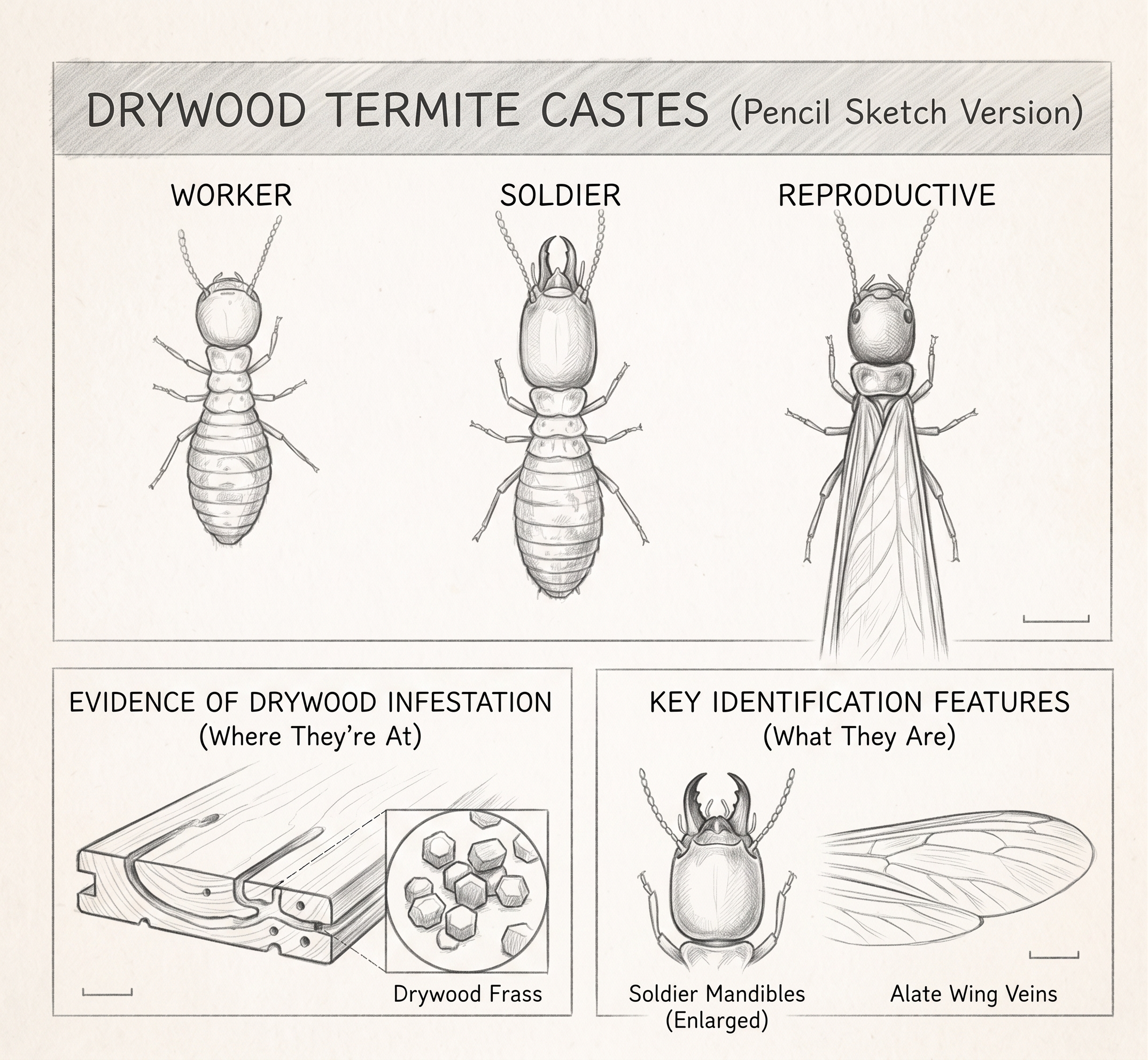
The three castes and the key signs to look for — worker, soldier, and reproductive, plus frass, mandibles, and wing veins.
They don't live in your yard. They live in your house.
Here's the thing that catches people off guard. Subterranean termites live in the soil and come up into your house to eat. That's why you see mud tubes running up a foundation wall. They have to keep a road back to the ground.
Drywood termites don't do any of that. The colony lives entirely inside the wood. They don't need soil, they don't need a water source, they don't need contact with the ground at all. They pull what water they need right out of the wood itself and out of the humid air we've got plenty of down here. That means the colony in your attic rafter has no connection to anything outside your house. It's just in there, living in the wood, eating the wood.
Which changes everything about how you treat it. You can't put down a barrier in the soil and solve a drywood problem. There's nothing crossing that soil.
The pile that keeps coming back
Termites have to get their waste out of the galleries they live in. So they chew a small hole to the outside, about the size of a pencil tip, and push the pellets out through it. Then they plug the hole back up with a bit of wet waste when they're done. That's why you'll find the pile but you often can't find the hole. It's sealed most of the time.

Drywood termite frass — the pile that keeps coming back after you sweep it.
The pellets themselves are distinctive if you look close. Each one is six-sided, like a tiny barrel with flat faces. Roll a few between your fingers and they feel dry and gritty, almost like sand. People describe the pile a few different ways. Sawdust. Coffee grounds. Salt and pepper. A little pile of dirt.
Now here's where almost everybody gets it wrong, and I hear this one constantly. The color doesn't tell you anything. Pellets come out cream, tan, reddish, dark brown, almost black. People see dark ones and figure the infestation is old, or see light ones and figure it's fresh. Neither is true. The color has nothing to do with the age of the pile, and nothing to do with the color of the wood they're eating. What matters isn't the color. What matters is whether the pile comes back after you sweep it.
The other things worth looking at
Wings show up on windowsills, on the kitchen counter, near a lamp, stuck in a spider web in the corner of the garage. They're little translucent things with nobody attached. That's from a swarm. The reproductives fly out, pair off, drop their wings, and go try to start a new colony somewhere. Usually somewhere else in the same house.
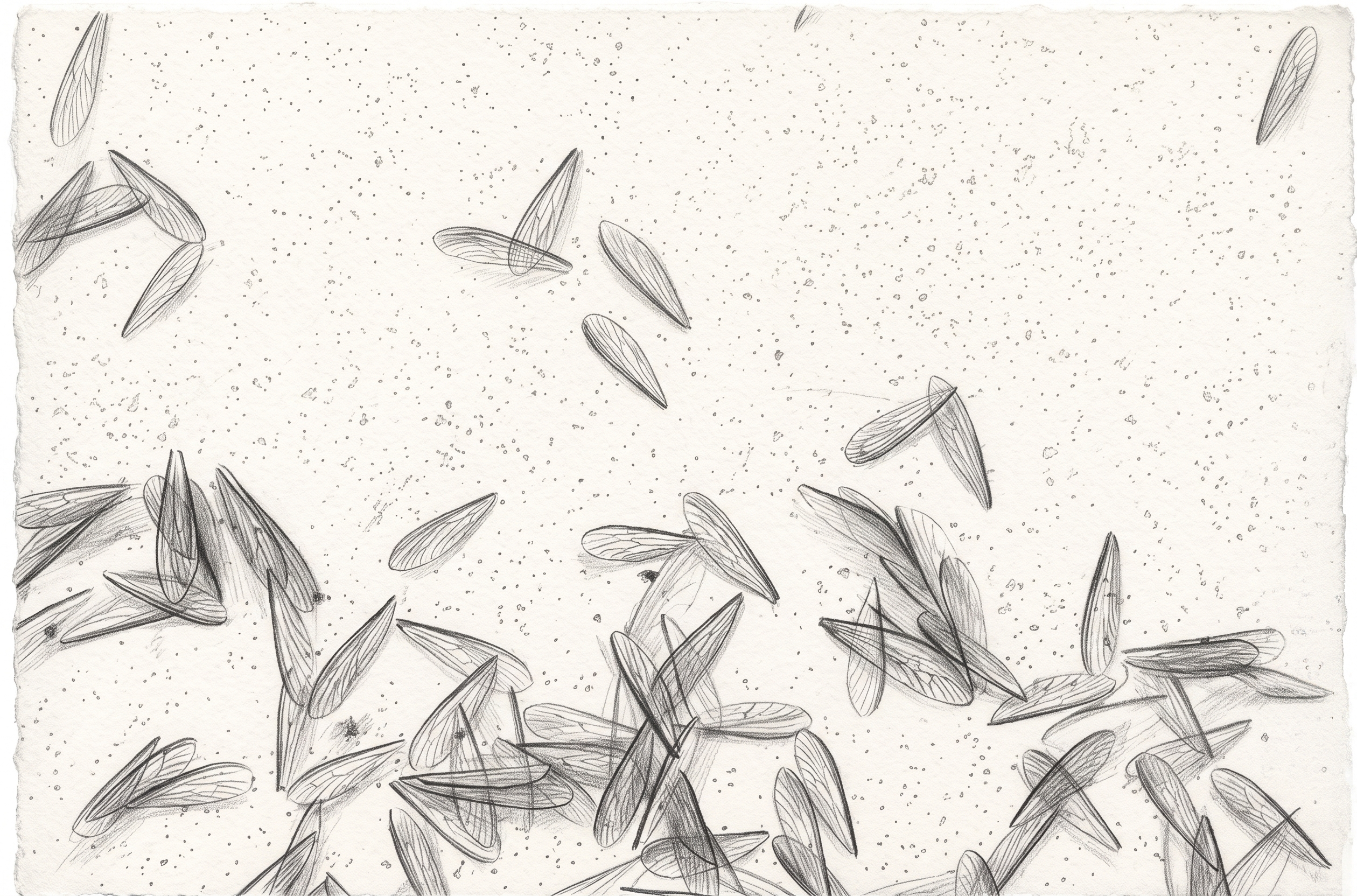
Discarded swarmer wings — the reproductives shed these right after they land.
Then there's the wood itself. Drywood termites tunnel just under the surface and leave a paper-thin shell of wood or paint on the outside. So the board looks fine. Press on it and it gives, or it sounds hollow when you tap it, or the paint has a blistered, wavy look to it like something is pushing up from underneath. That's late stage. By the time the surface is blistering, they've been in there a while.
Why they come back after a tenting
I want to be fair here, because this gets misrepresented a lot. Fumigation works. It's been around about a hundred years, the companies doing it are professionals doing a real job, and there are homes where I'll tell you straight that fumigating is the right call. If your house is loaded with colonies, tenting is faster than what I do. I'd take the tent in that situation and I'd tell you so.
But you should understand what you're buying. The gas kills everything living in the house that day. Then the tarps come off, the gas dissipates, and you go back inside. There's no residual. Nothing left behind in the wood, nothing protecting anything.
And here's the part that matters. Drywood termites don't form one big colony. A house can hold a dozen separate colonies that have nothing to do with each other, each one in its own piece of wood. When a mature colony starts throwing swarmers, those swarmers land somewhere. In an older neighborhood during swarm season, that's happening over and over across a stretch of weeks. Did the wind blow toward your house on those days, or away from it? Some days toward. So you fumigate, the house is clean for a while, and then the next swarm season starts and there's nothing in that wood to stop anything.
That's not a knock on fumigation. It's just what it is.
What we do instead
We treat the bare wood. As much of it as we can physically reach, which means the attic, the crawl space if you've got one, and inside the wall cavities through small injection points.
The product is a borate. If you've ever seen a box of 20 Mule Team Borax in a laundry aisle, you've seen the family it comes from. Specifically we use Borathor Max PT, made by Ensystex. It's inorganic, which is the whole point. Organic compounds break down over time. Inorganic ones don't. Once the borate has penetrated into the wood, nothing is known to pull it back out as long as that wood stays protected from moving water. The wood itself becomes something they can't live in.
So there are two things happening. It kills what's in there now, and it leaves the wood protected against the next thing that tries to move in. That second part is what fumigation can't do.
You stay in the house the whole time. We've treated homes with a customer on oxygen in the next room, homes with a fish tank running. Your pets stay, your kids stay, your pantry stays packed. We'd rather you step out of whichever room we're working in, and that's about the extent of it. You don't pull the screens off your pool cage. You don't cut back the shrubs against the house so the tarps don't kill them. Nobody's dragging a two hundred pound tarp across your roof.
When I'll tell you to tent instead
I'm not going to tell you tentless is right for every house, because it isn't. If we get in there and find colonies in so many separate places that chasing them all down would take us years, I'll say so. If the construction of your home means we can't reach enough bare wood to do the job right, I'll say that too. That conversation happens on your property, after we've actually looked, not on the phone and not on a website.
What I can tell you is we won't know which one your house is until we come out and look at it. That look costs you nothing.
Who's actually doing the work
I started in this trade in 1986, spraying lawns and chasing roaches and rats for years before termites ever became the focus. I founded this company in 2002 and started doing tentless work in 2003. From 2003 to 2016 I was personally on every single tentless job but five. That's over 2,500 homes and businesses.
My son Austin came into the business in 2013 and runs our termite work now. He learned it the same way I did, on the job, one house at a time. I'm the certified operator for the state of Florida on pest control and on wood destroying organisms, and Austin works under that certification.
There's no subcontractor. Nobody's selling your job to another company and marking it up. It's us.
The guarantee
If the bugs come back, so do we. You see something that concerns you, you call, and if it's an active termite infestation we treat it at no additional cost. That stays in force as long as you keep the annual renewal inspection current, and you can carry it for as long as you own the home.
One honest reason not to sit on it
A drywood colony takes several years to mature to the point where it starts throwing swarmers. Before that happens, you've got one colony in one piece of wood, and that's a straightforward job. Once it starts swarming, one colony becomes several, and several becomes dozens spread through the house.
The price doesn't change, by the way. We price on square footage under roof, so finding more colonies doesn't cost you more money. What changes is the wood. Damage doesn't come back. That's the part you can't undo later, and that's the only reason I'd tell anybody not to wait.
If you're seeing pellets, or wings, or a board that sounds hollow, call me and we'll come look at it.
As long as GOD keeps making them, we'll keep killing them.
Coby
Call 727-462-0400