
Termites With Wings in Your House: What Swarmers Mean and What to Do
If you've got a pile of little wings on a window sill, or a cloud of winged bugs came out of a wall, you're probably looking at termite swarmers. Swarmers coming out inside the house usually mean the colony is already in the structure. That's not a reason to panic tonight. It is a reason not to sit on it.
This page walks you through it in order. First, whether it's termites or flying ants. Then which termite it is, because that tells you a lot. Then what to do right now, before anybody comes out.
Found wings or swarmers? Text us a picture.
Snap a photo of the bugs or the wings, close up, and send it with your address. We'll tell you what it is. If it looks like termites, Austin, our termite tech, comes out, looks at where they came from, and tells you which termite it is and what it'll take. There's no charge to come look.
First, is it termites or flying ants?
Flying ants swarm too, and a lot of the calls we get about "flying termites" turn out to be ants. Color won't tell you, because both come in a lot of colors. Three things will.
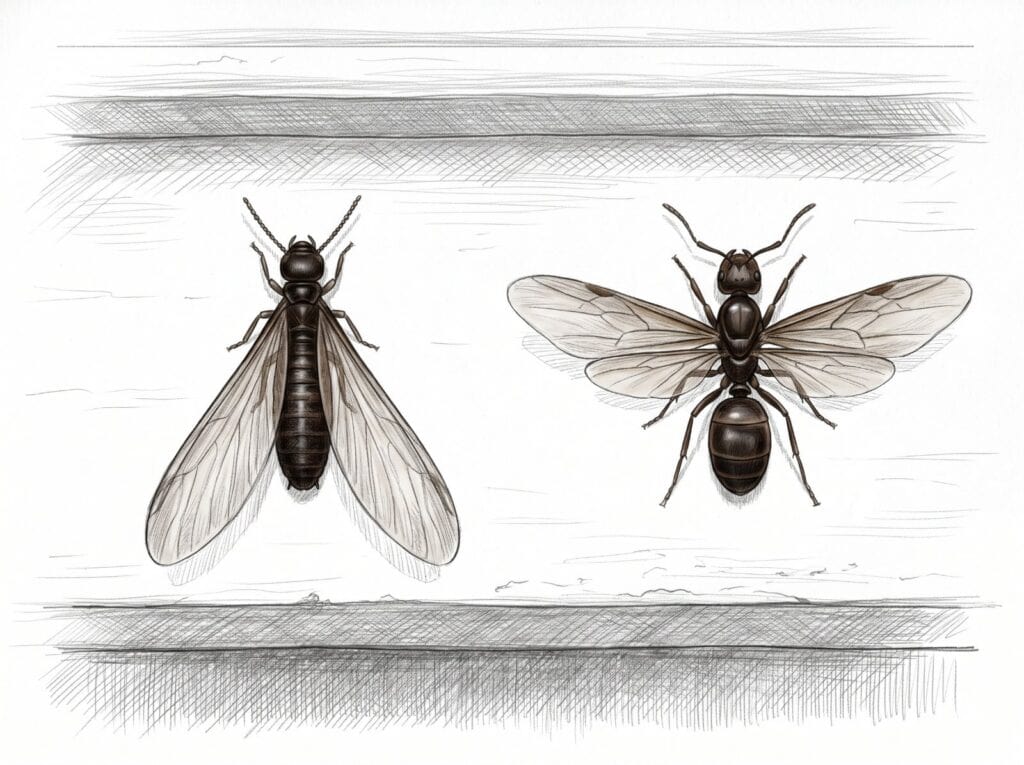
- The waist. Termites are thick all the way through, like a little cigar. Ants have a pinched waist, like an hourglass.
- The antennae. Termite antennae are straight. Ant antennae have a bend in them, like an elbow.
- The wings. Termites have four wings all the same length, and they're much longer than the body. Ants have a front pair that's longer than the back pair.
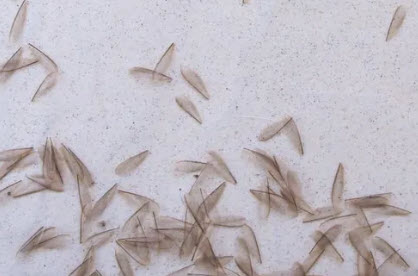
If all you've got is wings, that tells you something too. Drywood swarmers drop their wings once they land, so a little pile of identical wings on a sill with no bodies around is a strong sign of drywood termites. Our native subterranean swarmers usually turn up dead by a window, wings and all. I walk through what drywood wings look like, and why they pile up by the lights, in this podcast episode.
Which termite swarmed, and when
We've got three kinds of termites that swarm around homes here, and they don't keep the same hours. When you saw them, and where, narrows it down fast.
Not sure which you've got? That's what the picture is for. Text it to us and we'll tell you.
Inside or outside makes a big difference
Here's how I like to look at it. Swarmers are leaving home. A colony that's been growing for years sends them out to pair up and start new colonies somewhere else. So the question is where they came out of.
If they came out inside, out of a wall, a window frame, a baseboard, or up through the floor, the colony they came from is in the house. That's the one that needs dealing with.
If they're outside, flying around the porch light at night or coming up out of the yard, they may not be from your house at all. But think about where they're headed. Every one that lands on your house and finds a crack in bare, untreated wood can be the start of a new colony. That's how a house picks up drywood termites in the first place.
What to do right now
- Don't spray them and forget it. The ones flying around aren't the problem. The colony that sent them is, and a can of spray from the store never gets near it.
- Save a few. Catch a few on a piece of clear tape, or put them in a sandwich bag. Grab some wings too. If you can, snap a close-up picture on your phone.
- Note where and when. Which room, which window or wall, and what time of day. Daytime or after dark tells us a lot.
- Then clean up. Once you've saved a few, vacuum up the rest.
- Text us the picture. Put your address in the first message. We'll tell you what it is, and if it's termites, we'll set a time to come look.
Here's exactly what happens when you call
We set a time that works for you. Austin or I come out and look at where they came from and the wood around it. Then we tell you what kind of termite it is, how far it's gone, what it'll take, and what it'll cost, in plain English. We go out as if you'd paid us $10,000 for the advice, and we give you the best advice there is, whether we get the job or not. If it turns out you don't have termites, we'll tell you that too. There's no charge to come look and no obligation.
Texting? Put your address in the first message, and a picture if you've got one.
Why swarmers mean it's been there a while
A drywood colony takes about five years to get big enough to send out swarmers. So if you're seeing them come out of your walls, that colony didn't move in last month. And every swarm is how one colony turns into several. Caught early, it's a straightforward job. Caught late, I've seen it take years to track them all down.
That's not meant to scare you. It's just how they work. The termites eat on their own schedule, and wood damage is the one part of this that doesn't come back.
What we do about it
It depends on which termite came out, and that's why we look before we talk about anything else.
Drywood termites. We treat the whole house without a tent. That means as much bare wood as we can reach: the attic, the crawl space if you've got one, and inside the walls. The borate we use soaks into the wood and stays there. So it kills what's living in there now, and the wood keeps working against the next swarm that lands on your house. You don't bag up your pantry and you don't leave home. Now, if a house is loaded with colonies, or the wood is closed up where we can't reach it, I'll tell you to tent. I'd rather lose the job than sell you the wrong one. More on our drywood termite treatment.
Subterranean termites, including Formosans. The colony lives in the ground, so that's where the fight is. We trench around the house and treat the soil, then put in monitoring stations and check them every three months. A tent doesn't fix subterranean termites, because the colony isn't in the house to begin with. More on our subterranean termite treatment.
Want the whole picture, including the options we don't sell? Here's every termite treatment option, explained straight.
Questions people ask
When do termites swarm in Florida?
It depends on the termite. Our native subterranean termites swarm in the daytime from about January into May. Drywood termites swarm mostly April through June, from dusk into the night. Formosan termites swarm from about April into June, right after sunset, with most of it in May.
Do termite swarmers in my house mean I have termites?
If they came out inside, out of a wall, a window frame, or the floor, the colony they came from is usually in the house. If they're only outside around a light, they may have come from somewhere else, but they're looking for wood to start a new colony.
How do I tell flying termites from flying ants?
Termites have a thick waist, straight antennae, and four wings all the same length. Flying ants have a pinched waist, bent antennae, and front wings longer than the back ones.
Should I spray the swarmers?
Spraying kills the ones you hit, but the colony that sent them is somewhere else and never gets touched. Save a few for us to look at, vacuum up the rest, and have somebody find where they came from.
Why are the termites all around my lights at night?
Drywood and Formosan termites swarm after dark and fly to lights. If they're gathering around a lamp or the porch light, that's a good clue which termite you've got.
Our guarantee: If the bugs come back, so do we. That holds as long as you keep your annual renewal inspection current.
Seeing wings? Make one call before you do anything else
It costs you nothing to have it looked at. You'll know if it's termites, which termite it is, and what it'll take. Then you decide.
As long as GOD keeps making them, we'll keep killing them. Thanks, and you have a great day.
Coby
P.S. If the swarm is happening right now, don't wait on us to call back. Save a few, snap a picture, and text it while they're still there. The picture tells us more than anything you can describe.